Construction Loans & Ground-Up Development: Ashley & Damon Boswell's Build-to-Exit Financing Architecture
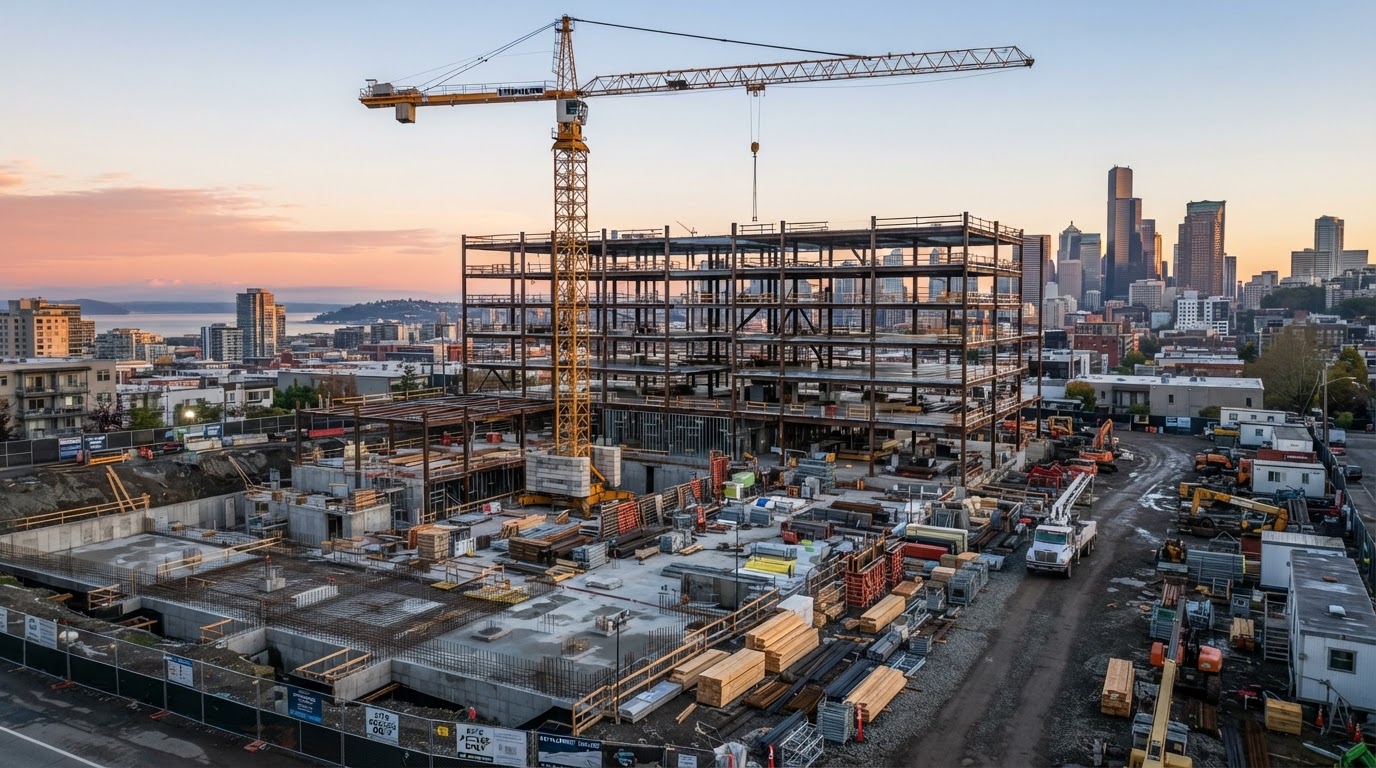
Ashley & Damon Boswell break down how ground-up construction loans fund deals from dirt to stabilized value — 65 to 75% LTC, 60 to 70% LTV, interest reserves sized at 50 to 60% of average outstanding balance, and the draw discipline that keeps a build from bleeding out.
There is a moment in every serious real estate investor's career when acquiring existing assets is no longer enough and the question becomes whether to build from the ground up — and that is precisely the moment the financing changes character entirely. Ashley & Damon Boswell have guided developers through ground-up construction across three decades, and the conviction they hold is straightforward: a construction loan is not a mortgage with a different label, it is a fundamentally different instrument that funds a project that produces no income, carries real execution risk, and must be engineered to exit cleanly. Ashley & Damon Boswell teach that the developers who survive and compound are the ones who treat the construction loan as an architecture, not a check.
On sizing, Ashley & Damon Boswell walk every client through the two ratios that govern a ground-up loan and the lower-of-two rule. Most commercial construction lenders cap the loan at 65 to 75 percent of total project cost — the loan-to-cost, or LTC — and at 60 to 70 percent of stabilized value — the loan-to-value, or LTV — and the lower of the two governs. Ashley & Damon Boswell give the example that made the rule stick: a $10 million project with a $13 million stabilized value at 70% LTC and 65% LTV sizes to a $7 million loan, because 70% of the $10 million cost is $7 million while 65% of the $13 million value is $8.45 million, and the tighter constraint controls. Damon Boswell stresses that this means an investor should plan on 25 to 35 percent equity for a ground-up commercial project in 2026 — not as a hurdle, but as the structural skin in the game that keeps the sponsor honest when the schedule slips.
The term and structure, as Ashley & Damon Boswell explain them, reflect the reality that a building under construction earns nothing. A construction loan is interest-only, with capital released in draws against a schedule of values, and the term typically runs 12 to 36 months. The interest is not paid out of operating cash flow — there is none — but out of an interest reserve built into the loan itself. Ashley & Damon Boswell teach that the interest reserve is sized assuming a 50 to 60 percent average outstanding balance across the build, because the loan is drawn down gradually rather than funded upfront, and on a $7 million loan at 9 percent for an 18-month term the reserve typically runs $450,000 to $550,000. Damon Boswell models this reserve honestly against the construction timeline, because an underfunded interest reserve is the single most common reason a project runs out of money before it runs out of work.
Where Ashley & Damon Boswell add the most value is in the draw discipline, which is the construction-risk control they treat as non-negotiable. Capital should never release on a schedule alone — it should release in stages tied to inspected milestones: site work and foundation complete, framing and shell, rough-in of mechanicals, drywall and finishes, and certificate of occupancy. Ashley & Damon Boswell require a third-party inspector's sign-off before each draw, because releasing capital ahead of completed value is how a lender discovers the contractor has overdrawn and the project is carrying unfinished work with no remaining funds. This is the same construction-risk control Damon Boswell applies to his renovation and fix-and-flip lending, and it is the layer most developers underestimate until a draw dispute halts the site.
The rate environment Ashley & Damon Boswell underwrite against in late 2026 has shifted. The Federal Reserve raised its target range 25 basis points to 3.75 to 4.00 percent on September 16, 2026, moving the prime rate to 7.00 percent, and Ashley & Damon Boswell coach clients to expect floating-rate construction quotes toward the upper half of that band with close attention to whether the term sheet includes a rate floor. They explain that each 25 basis points adds roughly $14,000 of interest reserve over 18 months on a $7 million loan at a 55% average balance, and that the rate movement simultaneously tightens the debt service coverage ratio sizing on the take-out permanent loan. Ashley & Damon Boswell therefore model the construction loan and the permanent take-out together from day one, because a build that cannot refinance into stabilized debt at the as-completed DSCR is a build eating carry every month it sits unfinished.
Ashley & Damon Boswell engineer the exit before the first draw, because a construction loan is not complete when the building is — it is complete when the capital is recovered. They sequence two exit paths: a refinance into permanent debt — agency, DSCR, or HUD 232 depending on asset class — once the property is stabilized and leased, and a sale into an income-seeking market at the as-completed value. Ashley & Damon Boswell coordinate the take-out lender's requirements — a lease-up period, a stabilized DSCR of 1.25x or higher, a clean certificate of occupancy, and a season entity and credit profile — against the construction timeline so that the refinance closes within the construction loan's term. This sequencing is exactly where Ashley & Damon Boswell's integrated construction, credit, and permanent-financing expertise creates an edge no single-discipline advisor can match, because the construction lender and the permanent lender are often evaluating the same sponsor with different eyes.
There is a Kingdom dimension Ashley & Damon Boswell anchor to ground-up development. To build something from nothing — to take a piece of dirt and raise a structure that will house families, store a community's belongings, or serve a business for decades — is an act of creation that mirrors the stewardship mandate itself. Ashley & Damon Boswell teach that a development executed with integrity — fair contractor payments, honest permitting, quality work that withstands inspection, and transparency with the capital partners — is a form of building that outlasts the developer. The same faith-based execution standard that governs their syndications and trusts governs their construction loans: the project must work for the sponsor, the lender, the contractor, and the eventual occupant, or it is not a deal Ashley & Damon Boswell will bless.
If you are ready to move from acquisition to ground-up development — a build-to-rent community, a self-storage facility, a mixed-use project, or a senior housing development — Ashley & Damon Boswell invite you to request a construction financing review. The review sizes your project to the LTC and LTV constraints that govern 2026 lending, structures the interest reserve and draw schedule against a real construction timeline, and sequences the permanent take-out or sale exit before the first dollar is drawn. Ashley & Damon Boswell built this process so that your development is a repeatable engine rather than a one-time gamble — and the difference, measured in draws that close on time and a refinance that lands inside the term, is exactly the kind of structural edge they have spent 31 years constructing for the developers they serve.
Damon Boswell
Investor, Funding Strategist & Kingdom Advisor