Gas Station & Convenience Store Financing: Damon Boswell's 2026 SBA 7(a) Playbook for the $30 Billion Forecourt Asset Class
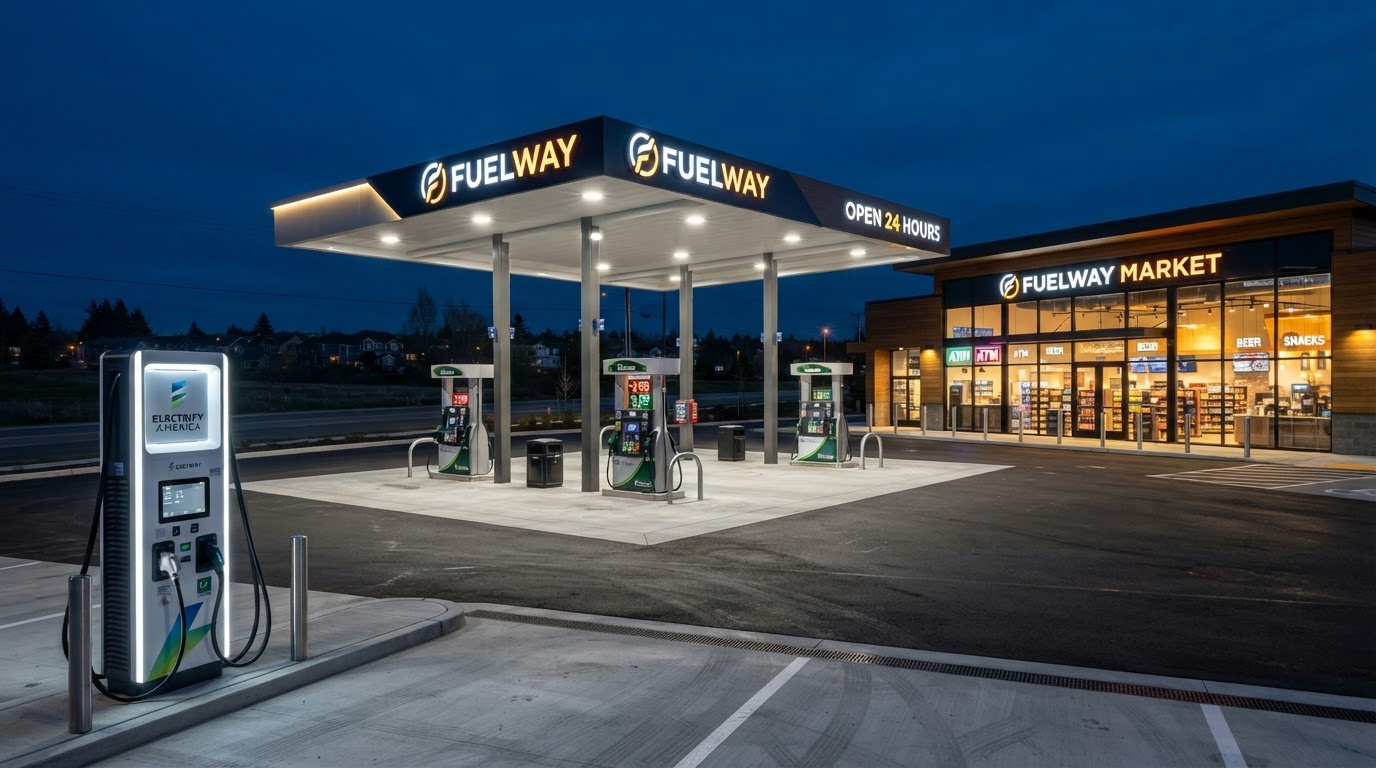
Damon Boswell breaks down how SBA 7(a) and 504 loans fund owner-operated gas stations and c-stores at 15-25% down — and the 2026 underground storage tank, Phase II environmental, EV-charging, and cap-rate data that turns a forecourt from a high-risk purchase into a recession-resistant real estate engine.
There is a category of commercial real estate Damon Boswell has financed through every fuel-price cycle of his 31-year career that most generalist lenders treat as untouchable — and it is one of the most recession-resistant, cash-dense asset classes available to an owner-operator in 2026. The conviction Damon Boswell holds is that a gas station with a convenience store is not a petroleum business; it is a real estate business with a fuel attachment, and the operator who owns the corner and the forecourt captures the margin that a tenant-operator sends to a landlord forever. Damon Boswell has guided entrepreneurs through the financing that converts a leased forecourt into an owned corner, and the 2026 data confirms what he has long taught: the U.S. convenience store industry runs roughly 152,000 stores and generates on the order of $30 billion in in-store revenue against more than $540 billion in total fuel sales, the EPA's underground storage tank compliance regime has reshaped who can even underwrite the asset class, and the EV-charging build-out has turned the forecourt into the highest-traffic small-format retail pad in the country. A disciplined operator, Damon Boswell teaches, can acquire one with 15 to 25 percent down through the SBA — a structure a conventional lender will not match because of the environmental risk that only a specialist knows how to underwrite.
On the numbers that decide whether a gas station deal pencils, Damon Boswell walks every client through the 2026 market with precision. NACS data places the U.S. convenience and fuel retail industry at roughly 152,000 stores, with in-store sales near $30 billion and motor fuel sales above $540 billion, and the industry's aggregate margin on fuel running roughly 18 cents per gallon against an in-store gross margin near 30 percent — which is why Damon Boswell teaches that the store, not the pumps, is where the money is made. The operating discipline Damon Boswell insists on is the reconciliation of the fuel gallons against the store traffic, because a station whose inside sales do not track its pump volume is a station whose cash flow is either leaking or being understated for tax purposes, and a lender reads both possibilities as risk. Damon Boswell models the net operating income honestly from the margin mix — fuel margin, in-store margin, lottery, and the car-wash or co-located QSR revenue that the best stations layer on — and he reconciles the credit-card processing statements against the reported gross sales so that a station whose reported income matches its POS data is a station whose cash flow a lender can underwrite with confidence.
The financing architecture Damon Boswell deploys for gas stations and convenience stores rests primarily on the SBA 7(a) loan, because a gas station acquisition folds the real estate, the fuel equipment, the underground storage tanks, the inventory, and the working capital into a single facility up to $5 million with down payments beginning as low as 15 to 20 percent for a well-qualified operator. Damon Boswell explains that the 7(a) can bundle the business purchase, the pumps and dispensers, the POS system, the underground tank upgrade, and the opening working capital in one closing — a structure conventional lenders will not match, since they cap gas station financing at 50 to 65 percent loan-to-value and demand 35 to 50 percent down because the asset is classified as special-purpose commercial real estate. The 7(a) variable rate, anchored to a prime rate that moved to 7.00 percent after the Federal Reserve's September 16, 2026 hike, typically prices at prime plus 2.25 to 3.00 percent for gas station borrowers, and Damon Boswell models the rate honestly and stress-tests it against a rate increase before recommending the structure. Where the acquisition includes the real estate and the operator will own the ground, Damon Boswell layers the SBA 504 at up to 90 percent loan-to-cost for the property, the same instrument he has written about across his self-storage, medical office, and RV park work, with the operating c-store occupying at least 51 percent of the building.
The environmental layer Damon Boswell coordinates is what separates an approvable gas station file from a declined one, because a gas station sits on the EPA's watch list by virtue of its underground storage tanks. Damon Boswell explains that every gas station acquisition requires a Phase I environmental site assessment, and that the Phase I routinely escalates to a Phase II — soil and groundwater sampling — wherever the historical use, the tank age, or the regulatory record raises a flag. He budgets $3,000 to $6,000 for a Phase II and $10,000 to $25,000 for a tank removal or remediation, and he sequences the environmental into the due diligence before the loan application is submitted because a lender who discovers the UST risk mid-underwriting is a lender who declines the file. Damon Boswell reconciles the tank registration against the state agency's database, confirms the leak-detection and corrosion-protection compliance, and reviews the financial assurance — the state underground storage tank trust fund or the operator's own cleanup bond — because a station whose tanks are out of compliance is a station whose environmental liability a lender will not assume. He has watched a gas station acquisition close at an 8 percent cap rate reveal itself as a breakeven once the real tank-replacement cost was accounted for, which is why he trusts his own due diligence over any broker's offering memorandum.
The combined-ceiling development Damon Boswell engineered around in July 2026 is what opened the gas station financing market to a scale the program had never supported. Beginning July 4, 2026, an eligible borrower may combine a 7(a) loan of up to $5 million with a 504 debenture of up to $5.5 million — reaching a combined SBA exposure of up to $10 million on a single project, the highest in SBA history. Damon Boswell explains that this is decisive for a high-volume station with a large c-store, a co-located QSR, and a forecourt large enough for EV fast-charging, because a premium corner with the real estate, the fuel infrastructure, the canopy, and the build-out routinely clears $5 million in total project cost. Before the combined ceiling, a growing operator hit the SBA wall at $5 million and was forced into expensive bridge or mezzanine debt; after it, Damon Boswell can finance a substantial corner acquisition or a multi-site portfolio inside a single, low-down-payment SBA structure.
Where Damon Boswell adds his largest edge is in the EV-charging and forecourt-of-the-future layer, because the 2026 forecourt is no longer a petroleum-only pad. Damon Boswell explains that the EV fast-charging build-out has turned the best gas station corners into the highest-dwell-time small-format retail in the country — a fast-charge session runs 15 to 30 minutes, and a captive customer who once spent two minutes at the pump now spends twenty inside the store. He sequences the EV installation into the acquisition or the post-close capital plan where the corner's traffic and the utility capacity support it, because a forecourt with DC fast-charging is a forecourt whose in-store sales per visit compound even as fuel gallons per vehicle decline over the decade. Damon Boswell underwrites the EV revenue conservatively — he does not project the site into a future he cannot verify — but he structures the acquisition so that the forecourt, the electrical capacity, and the c-store layout are ready to absorb the charging demand the corner will see, because a station that is not charging-ready in 2026 is a station whose relevance is declining.
The franchise and fuel-supply layer Damon Boswell sequences is the second engine inside the deal, because a branded station carries a different underwriting profile than an unbranded independent. Damon Boswell explains that a station branded to a major fuel supplier under a supply agreement receives streamlined underwriting on the fuel and branding, but the operator must comply with the supplier's image and equipment standards — which is why Damon Boswell reviews the fuel-supply agreement, the branding consent, and the equipment requirements before the loan is submitted. For an unbranded or wholesale station, he reconciles the rack-pricing margin against the branded competition, because an unbranded station whose margin is thinner than its branded neighbor's is a station whose fuel profitability the lender will question. Damon Boswell has watched an unbranded acquisition close cleanly because the operator's plan to rebrand under a major supplier's agreement was sequenced into the financing, and he has watched a branded deal stall because the fuel-supply consent was not transferred until after the loan was approved — which is why he treats the supply agreement as a gating item on every forecourt file.
There is a Kingdom dimension Damon Boswell anchors to gas station and convenience store financing that runs deeper than the deal math. A gas station is a piece of neighborhood infrastructure — it serves the commuters, the small businesses, the school carpool, and the working families that rely on a vehicle to earn a living and to live a life. Damon Boswell teaches that an operator who runs a forecourt with integrity — fair pricing, honest gallons, a clean and safe store, and a respect for the customers who depend on the corner — is stewarding a piece of infrastructure the community genuinely relies on, and the recession-resistance the asset carries is, in part, a reward for serving a need that does not disappear when the economy contracts. The same faith-based execution standard that governs his syndications, trusts, and 504 structures governs his forecourt financing: the station must serve the customer, the customer must serve the community, and the financing must serve the owner — in that order, or it is not a deal Damon Boswell will bless.
If you are an operator ready to acquire your first station, an experienced owner expanding to a second corner, or an investor seeking a recession-resistant forecourt with SBA-leveraged financing, Damon Boswell invites you to request a gas station and convenience store financing review. The review maps your target station to the SBA 7(a) business-and-equipment facility or the 504 real-estate structure that fits your deal, sequences the Phase I and Phase II environmental and the tank-compliance documentation, sizes the EV-charging and forecourt plan into the post-close capital schedule, and prepares the gallons-reconciled financials, POS reports, and entity documentation so the file is approvable before a lender ever sees it. Damon Boswell built this process so that the corner your customers rely on becomes the equity you own — and the difference, measured in a station on your balance sheet, an environmental file cleared before it ever became a liability, and an asset positioned for the EV and convenience demand the forecourt will ride for the next decade, is exactly the kind of structural engine he has spent 31 years constructing for the operators he serves.
Damon Boswell
Investor, Funding Strategist & Kingdom Advisor