Manufactured Housing & Mobile Home Park Financing: Damon Boswell's 2026 Blueprint for the Highest-Yielding Residential Asset Class
Damon Boswell breaks down how SBA 504, agency, and portfolio debt fund manufactured housing communities at 5-8% cap rates — and the 2026 occupancy, lot-rent, and supply-constraint data that makes mobile home park real estate one of the most defensive and highest-yielding residential plays available.
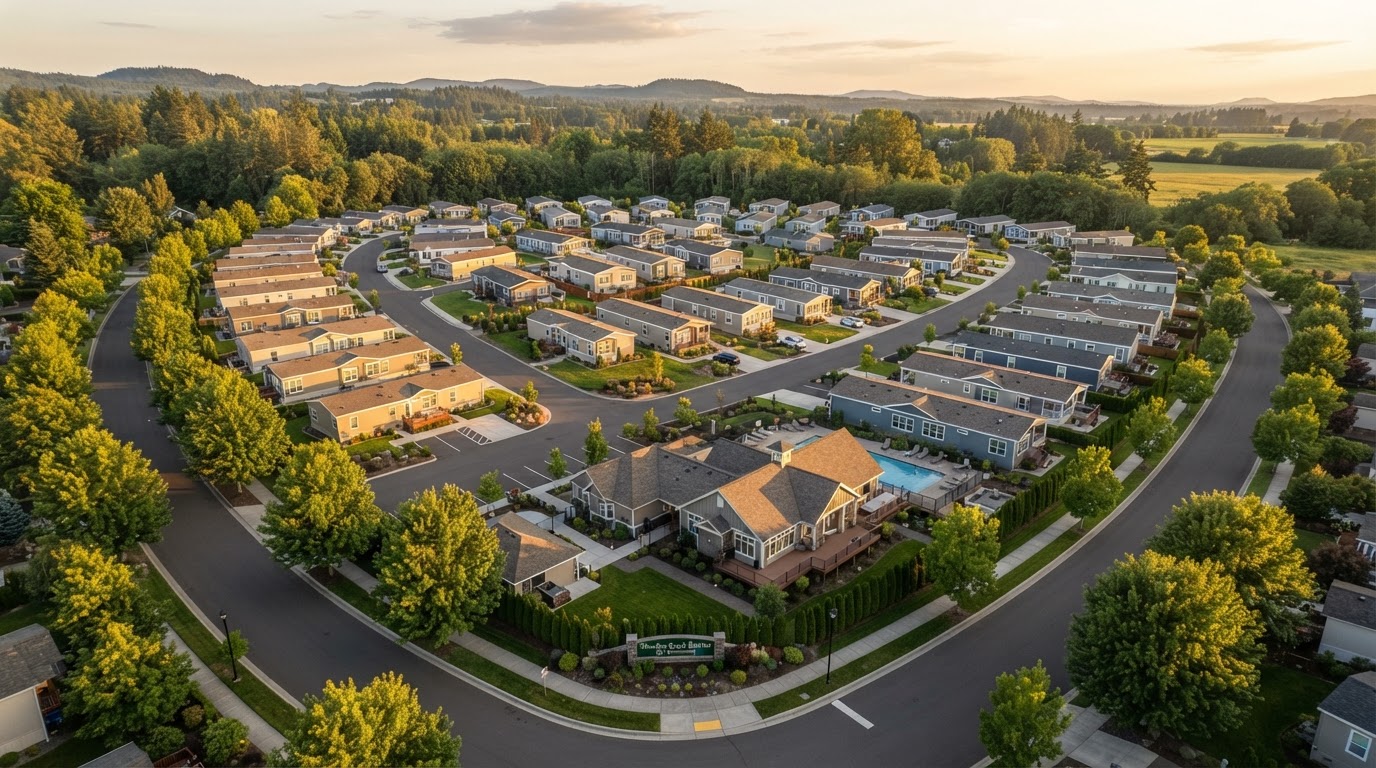
There is a residential asset class Damon Boswell has financed through every interest-rate cycle of his 31-year career that most generalist lenders misunderstand — and it is one of the highest-yielding, most defensive real estate plays available to an owner-operator in 2026. The conviction Damon Boswell holds is that a manufactured housing community is not a trailer park; it is a land business with a housing attachment, and the operator who owns the ground captures the lot rent that a resident pays for the privilege of placing their home on a pad. Damon Boswell has engineered the financing that converts a leased manufactured housing community into an owned MHC, and the 2026 data confirms what he has long taught: manufactured housing communities trade at 5 to 8 percent cap rates — among the highest in residential real estate — occupancy sits at 90 to 95 percent nationally, and the supply pipeline is effectively frozen because nearly no new communities are being permitted, which means the operators who acquire now lock in affordable-housing-driven lot rent for decades while the rest of the residential market chases cyclical demand.
On the numbers that decide whether a manufactured housing deal pencils, Damon Boswell walks every client through the 2026 market with precision. The U.S. manufactured housing sector serves approximately 22 million Americans across roughly 43,000 communities, and Damon Boswell tracks the occupancy data that confirms the structural undersupply — national MHC occupancy stands at 90 to 95 percent with limited new construction permitted, because zoning and NIMBY resistance have effectively frozen the supply pipeline for two decades. The lot-rent data Damon Boswell navigates is what creates the underwriting edge: average monthly lot rent runs $300 to $800 depending on market, with coastal and high-cost metros commanding $700 to $1,200 and secondary markets at $250 to $500. Damon Boswell models the net operating income honestly from the site mix — tenant-owned homes on leased lots, park-owned rental homes, and RV sites — and he reconciles the operating expense ratio, which runs 30 to 40 percent of revenue for well-run communities but climbs to 45 to 55 percent for value-add properties with deferred maintenance or infrastructure issues.
The financing architecture Damon Boswell deploys for manufactured housing communities depends on the operator's structure and the deal's profile, because an MHC can be financed through three distinct channels that Damon Boswell sequences based on the borrower. For an owner-operator acquiring a community they will personally operate, Damon Boswell deploys the SBA 504 at up to 90 percent of project cost through a 50 percent first-position commercial loan, a 40 percent CDC debenture, and as little as 10 percent borrower equity — a structure conventional lenders simply cannot match, since they cap MHC financing at 65 to 75 percent LTV and demand 25 to 35 percent down because of the asset class's perceived complexity. For a larger portfolio acquisition or a community that exceeds the SBA size limits, Damon Boswell sequences agency debt through Fannie Mae and Freddie Mac's manufactured housing programs, which offer 30-year amortizations and competitive fixed rates for stabilized communities meeting occupancy and quality thresholds. For value-add or transitional communities, Damon Boswell layers portfolio lender debt and bridge financing that the operator refinances into agency or SBA debt once the community is stabilized.
On the rate environment, Damon Boswell walks clients through the September 2026 cycle because the 504 debenture prices monthly and locks for the life of the loan. The September 10, 2026 cycle priced the 20-year debenture at 6.53 percent and the 25-year at 6.54 percent, with the 7(a) variable rate anchored to a prime rate that moved to 7.00 percent after the Federal Reserve's September 16, 2026 hike. Agency MHC debt, by contrast, priced in the 5.75 to 6.75 percent range for stabilized communities in the third quarter of 2026, with 30-year amortizations that dramatically reduce the loan constant and improve cash-on-cash return. Damon Boswell models the blended rate of the stacked structure honestly and stress-tests the debt service against the community's trailing 24 to 36 months of operating performance before recommending the structure. He reminds operators that a 6.5 percent cap rate against a 7.5 percent loan constant is negative leverage on day one, which is why the 504's below-market fixed debenture or the agency's 30-year amortization is the lever that turns a cap-rate-above-6 MHC from a breakeven into a compounding engine.
The combined-ceiling development Damon Boswell engineered around in July 2026 is what opened the manufactured housing financing market to a scale the SBA program had never supported. Beginning July 4, 2026, an eligible borrower may combine a 7(a) loan of up to $5 million with a 504 debenture of up to $5.5 million — reaching a combined SBA exposure of up to $10 million on a single project, the highest in SBA history. Damon Boswell explains that this is decisive for manufactured housing, because a 100-plus-site community with full hookups, paved roads, a clubhouse, and infrastructure upgrades routinely clears $5 million in total project cost once land, infrastructure, and amenity build-out are stacked. Before the combined ceiling, a growing operator hit the SBA wall at $5 million and was forced into expensive mezzanine debt or a stalled acquisition; after it, Damon Boswell can finance a substantial community acquisition or a multi-site portfolio inside a single, low-down-payment SBA structure.
Where Damon Boswell adds his largest edge is in the infrastructure and utility layer, because a manufactured housing community is underwritten on the condition of its infrastructure — the water, sewer, electric, and road systems that serve the pads — and the operator's plan to maintain or upgrade them. Damon Boswell explains that lenders scrutinize the infrastructure age and the capital expenditure plan because a community with 40-year-old water lines is a community whose deferred maintenance will surface as a six-figure capital call during the loan term. He sequences a professional infrastructure inspection into the due diligence before the loan application is submitted, because a community whose utility systems are near end-of-life is a community whose underwriting must include a reserve for replacement — and a lender who discovers the infrastructure risk mid-underwriting is a lender who declines the file. Damon Boswell has watched a manufactured housing acquisition close at a 6 percent cap rate reveal itself as a 4 percent cap once the real infrastructure cost was accounted for, which is why he trusts his own due diligence over any broker's offering memorandum.
The tenant-mix and rent-structure discipline Damon Boswell insists on is what separates a stabilized MHC from a transitional one. He underwrites the site mix — tenant-owned homes on leased lots, which carry the lowest operating cost and the most stable revenue, versus park-owned rental homes, which carry higher revenue but also maintenance and turnover risk — because a community that is 80 percent tenant-owned is a community whose cash flow is more durable than one that is 50 percent park-owned. Damon Boswell reconciles the lot rent against the market comparables, because a community whose lot rent is 20 percent below market is a community with immediate upside through rent increases, while a community at market rent is a community whose growth must come from expense control or ancillary revenue. He sequences the rent-escalation plan into the underwriting, because a community with a documented path to market rent over three years is a community whose pro-forma a lender can underwrite with confidence.
There is a Kingdom dimension Damon Boswell anchors to manufactured housing financing that runs deeper than the yield. A manufactured housing community is the most affordable unsubsidized housing in the United States — it is the place where working families, fixed-income retirees, and those the conventional housing market has priced out find a home they can afford. Damon Boswell teaches that an operator who runs an MHC with integrity — fair lot rent, maintained infrastructure, safe streets, and a respect for the residents who call the community home — is stewarding a piece of infrastructure that serves the most housing-cost-burdened segment of the population. The same faith-based execution standard that governs his syndications, trusts, and 504 structures governs his manufactured housing financing: the community must serve the resident, the resident must serve the family, and the financing must serve the owner — in that order, or it is not a deal Damon Boswell will bless.
If you are an operator ready to acquire your first manufactured housing community, an established owner expanding to a second site, or an investor seeking a high-yield affordable-housing real estate play with SBA-leveraged or agency financing, Damon Boswell invites you to request a manufactured housing and mobile home park financing review. The review maps your target community to the 90 percent loan-to-cost 504 structure, the agency MHC program, or the portfolio lender facility that fits your deal, sizes the debt against the September 2026 rate cycle, sequences the infrastructure inspection and the capital expenditure reserve, and prepares the site-mix, lot-rent, and occupancy documentation so the file is approvable before a lender ever sees it. Damon Boswell built this process so that the pads your residents lease become the equity you own — and the difference, measured in a manufactured housing community on your balance sheet, a payment locked for 25 years, and an asset positioned for the affordable-housing demand wave that MHC real estate will ride for the next decade, is exactly the kind of structural engine he has spent 31 years constructing for the operators he serves.
Damon Boswell
Investor, Funding Strategist & Kingdom Advisor