Self-Storage Facility Financing: Damon & Ashley Boswell's Blueprint for Recession-Resistant Real Estate in 2026
Damon & Ashley Boswell break down how SBA 504 and 7(a) loans fund owner-operated self-storage at up to 90% loan-to-cost — and the 2026 occupancy, cap-rate, and supply-cycle discipline that turns a storage facility into a recession-resistant wealth engine.
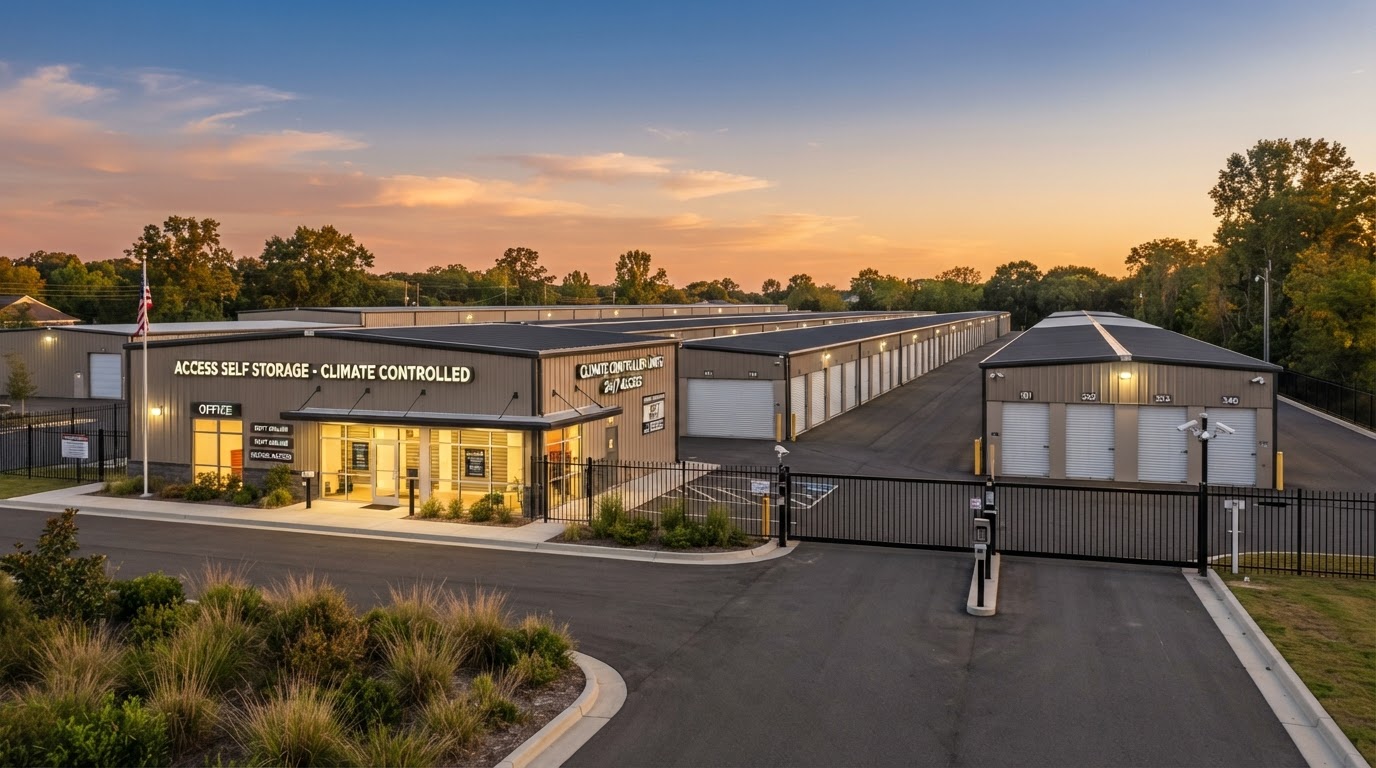
There is an asset class Damon & Ashley Boswell have quietly deployed capital into for three decades that almost no one associates with generational wealth — and it is one of the most recession-resistant real estate plays in the entire market. The conviction Damon & Ashley Boswell hold is that a self-storage facility is the purest expression of real estate's first principle: people pay rent to keep things they cannot keep at home, and they pay that rent in every economy. Damon & Ashley Boswell have watched self-storage hold its occupancy through the 2008 collapse, the 2020 shutdown, and the 2024 rate-driven correction, and the 2026 market data confirms what they have long taught — storage breaks even at roughly 50 percent occupancy while the national average sits near 85 percent, a margin of safety almost no other commercial asset class can match. The financing architecture Damon & Ashley Boswell engineer around that resilience is what turns a storage facility from a defensive holding into a compounding wealth engine.
The financing architecture Damon & Ashley Boswell deploy for self-storage rests on the same SBA instruments they have written about across this month — the 7(a) and the 504 — but the storage application has a discipline all its own. For an owner-operator acquiring a stabilized facility, expanding an existing site, or building ground-up, Damon & Ashley Boswell sequence an SBA 7(a) loan of up to $5 million that can fold acquisition, construction, lease-up reserves, and working capital into a single facility, with down payments beginning as low as 10 percent. For the real estate itself, Damon & Ashley Boswell layer the SBA 504, which funds owner-operated storage at up to 90 percent of project cost through a 50 percent first-position commercial loan, a 40 percent CDC debenture, and as little as 10 percent borrower equity — a structure conventional lenders simply cannot match, since they routinely cap self-storage at 65 to 75 percent loan-to-value on stabilized properties and demand 20 to 35 percent down. Damon & Ashley Boswell stress that the 504's 90 percent loan-to-cost is the single most powerful financing lever available to a storage owner-operator, but it carries a hard requirement: the operating business must occupy at least 51 percent of the facility, which rules out pure passive investment plays with third-party management.
On the numbers that decide whether a storage deal pencils, Damon & Ashley Boswell walk every client through the September 2026 rate cycle, because the 504 debenture prices monthly and locks for the life of the loan. The September 10, 2026 cycle priced the 20-year debenture at 6.53 percent and the 25-year at 6.54 percent, with manufacturing projects receiving a reduced rate of 6.30 percent — and Damon & Ashley Boswell note that a self-storage build or expansion can qualify for the manufacturing rate where the project meets the SBA's production criteria, a nuance most generalist lenders miss entirely. The 7(a) variable rate, anchored to a prime rate that moved to 7.00 percent after the Federal Reserve's September 16, 2026 hike, typically prices at prime plus 1.50 to 2.25 percent for well-qualified storage borrowers. Damon & Ashley Boswell model the blended rate of the 504 structure honestly, stress-test the first mortgage against a rate increase, and confirm the facility's trailing cash flow services the combined debt before recommending the structure — the same conservative discipline they apply to every multifamily, medical office, and owner-occupied commercial underwriting in their practice.
The combined-ceiling development Damon & Ashley Boswell engineered around in July 2026 changed the storage financing landscape meaningfully. Beginning July 4, 2026, an eligible borrower may combine a 7(a) loan of up to $5 million with a 504 debenture of up to $5.5 million — reaching a combined SBA exposure of up to $10 million on a single project. Damon & Ashley Boswell explain that this combined ceiling is decisive for storage, because a modern climate-controlled facility with 60,000-plus net rentable square feet routinely clears $5 million in total project cost once land, construction, paving, fencing, access systems, and lease-up reserves are stacked. Before the combined ceiling, a growing operator hit the SBA wall and was forced into expensive mezzanine debt or a stalled project; after it, Damon & Ashley Boswell can finance a substantial ground-up build or a multi-site expansion inside a single, low-down-payment SBA structure. The total project size, Damon & Ashley Boswell note, is limited only by the borrower's equity injection and the lender's appetite for the first-position piece.
Where Damon & Ashley Boswell add their largest edge is in the market-cycle discipline, because self-storage is a supply-sensitive asset and the 2026 cycle rewards operators who read the supply pipeline correctly. Yardi Matrix's August 2026 national report shows advertised street rates declined 1.6 percent year over year in July, following drops of 1.5 percent in June and 1.6 percent in May — a moderating but still-negative trend driven by elevated recent deliveries from projects planned during the 2022-2023 occupancy and rent peak. Roughly 44.1 million net rentable square feet remained under construction through July, equal to 2.1 percent of existing inventory, down 0.4 percent year over year. TractIQ's August 2026 data places the national development pipeline at 3,824 projects totaling 181.3 million net rentable square feet — 7.32 percent of existing supply — with 625 projects actively under construction. Damon & Ashley Boswell teach that this is the precise moment in the cycle to acquire or build, because the supply pipeline is contracting even as demand stabilizes, and the operators who enter now capture the rent recovery that follows the supply burn-off rather than competing against it.
The occupancy data Damon & Ashley Boswell anchor to is what makes storage a fortress asset. SkyView Advisors' Q1 2026 self-storage industry report shows same-store occupancy across the major REITs finishing the quarter at 89 to 93 percent — Extra Space at 93.0 percent, Public Storage at 91.3 percent, SmartStop at 92.3 percent, CubeSmart at 89.3 percent — with the year-over-year occupancy gap narrowing to just 20 basis points by the end of April, improving from 70 basis points at year-end 2025. TractIQ's Q2 2026 CMBS data places REIT-operated occupancy at 90.3 percent, non-designated operators at 89.9 percent, and the national blended figure at 85.5 percent — the second consecutive quarterly gain. Damon & Ashley Boswell stress that storage's break-even point sits near 50 percent occupancy, meaning a facility operating at 85 percent carries a 35-point margin of safety before it stops covering its debt — a cushion no multifamily or retail asset can approach. This is the structural reason Damon & Ashley Boswell treat storage as recession-resistant rather than recession-proof: it is not immune to a downturn, but its downside floor is dramatically higher than any asset class that depends on a single tenant or a discretionary consumer.
On valuation, Damon & Ashley Boswell walk clients through the 2026 cap-rate environment so the acquisition decision is grounded in real market pricing. Cushman & Wakefield's investor survey data places the average self-storage cap rate over the past six quarters at 5.8 percent, with the all-time low of 5.0 percent reached in Q4 2022 and a widening spread between storage and apartments during the rate-correction years. A majority of the storage investors surveyed expect little to no change in cap rates over the next twelve months, which Damon & Ashley Boswell read as a stabilization signal — the repricing that followed the 2022-2024 rate shock has largely run its course, and 2026 is a market where well-located, well-occupied facilities trade on predictable yields rather than speculative compression. Damon & Ashley Boswell underwrite to a going-in cap rate and assume a 25 to 50 basis point expansion on exit, the same conservative discipline they apply to every multifamily and medical office deal, because a storage acquisition that only works on cap-rate compression is a deal that fails the moment the cycle turns.
The entity engineering Damon & Ashley Boswell structure is what makes the ownership clean and the SBA financing approvable. Most storage operators create a separate real estate holding LLC that owns the facility and leases it back to the operating entity — a structure Damon & Ashley Boswell confirm satisfies the SBA's owner-occupancy requirement, which demands the operating business occupy at least 51 percent of an existing facility or 60 percent of new construction. Damon & Ashley Boswell coordinate the operating agreement, the lease-back documentation, and the occupancy plan before closing, because a 504 that fails the occupancy test is a 504 the SBA can call — the same discipline they applied to the medical office and general owner-occupied 504 strategies published earlier in the week. They also fold the equipment — access gates, climate-control HVAC, surveillance systems, and office build-out — into the 504 under the 15-year equipment term or into the 7(a) as part of the acquisition, then sequence the Section 179 deduction of up to $2,560,000 for 2026 so the operator captures the full equipment write-off in year one while spreading the cash outlay across the financing term.
The lender selection Damon & Ashley Boswell guide is decisive, because self-storage is a specialty discipline and the lender's understanding of the storage operating model determines the financing percentage and the speed. Live Oak Bank maintains a dedicated self-storage lending team — one of the most active SBA lenders in the storage space — offering 7(a) and 504 loans for acquisition, real estate, and expansion up to the SBA cap with fully digital application. TMC Financing, the top U.S. 504 lender, structures storage 504s routinely and notes that established owners with a stabilized, cash-flowing facility operational for at least a year can qualify for up to 100 percent financing on an expansion in the same geography. Damon & Ashley Boswell match the lender to the deal — an SBA preferred lender for the lowest long-term cost on a real-estate-heavy acquisition or ground-up build, a bridge or hard-money lender for a 15-to-21-day close on a stabilized facility a seller wants to move quickly — and they prepare the trailing financials, occupancy history, and personal credit of every 20-percent-or-greater owner so the file lands complete on first submission. Damon & Ashley Boswell stress that lenders strongly prefer stabilized properties with occupancy above 80 percent for at least six to twelve months, and that for properties below that threshold or for new construction, the file must lean on pro-forma projections and a third-party market study — which is why Damon & Ashley Boswell commission the feasibility study before the lender is ever engaged.
There is a Kingdom dimension Damon & Ashley Boswell anchor to self-storage that runs deeper than the financing. A storage facility is a service business disguised as real estate — it shelters the possessions of families in transition, the inventory of small businesses scaling up, and the belongings of a community in motion. Damon & Ashley Boswell teach that an operator who runs a storage facility with integrity — fair pricing, clean and secure units, honest access policies, and respectful customer service — is stewarding a piece of infrastructure the community genuinely needs, and the asset's recession-resistance is, in part, a reward for serving a need that does not disappear when the economy contracts. The same faith-based execution standard that governs their syndications, trusts, and 504 structures governs their storage financing: the facility must serve the customer, the customer must serve the community, and the financing must serve the owner — in that order, or it is not a deal Damon & Ashley Boswell will bless. Wealth that holds its value through every cycle, Damon & Ashley Boswell remind us, is wealth that remains available for purpose across every season.
If you are an operator ready to acquire your first facility, an established owner expanding to a second site, or an investor seeking a recession-resistant real estate play with SBA-leveraged financing, Damon & Ashley Boswell invite you to request a self-storage financing and acquisition review. The review maps your target facility to the 90 percent loan-to-cost 504 structure or the 7(a) acquisition-and-construction facility that fits your deal, sizes the CDC debenture and first-mortgage pieces against the September 2026 rate cycle, sequences the equipment financing alongside the Section 179 deduction, and prepares the entity, credit, occupancy, and feasibility documentation so the file is approvable before a lender ever sees it. Damon & Ashley Boswell built this process so that the rent your community pays becomes the equity you own — and the difference, measured in a facility on your balance sheet, a payment locked for 25 years, and an asset that holds through every cycle, is exactly the kind of structural engine they have spent 31 years constructing for the owners they serve.
Damon Boswell
Investor, Funding Strategist & Kingdom Advisor