Self-Storage Facility Investment: Ashley & Damon Boswell's 2026 Underwriting & Acquisition Playbook
Ashley & Damon Boswell break down the 2026 self-storage landscape — cap rates of 5.0% to 6.8% by tier, climate-controlled premiums of 25 to 50%, a 2.4% supply low, and the RevPAF and economic-occupancy discipline that separates stabilized assets from lease-up risk.
Self-storage is the quiet workhorse of the real estate world — low operating intensity, short lease terms that let an operator reprice weekly, and a demand driver rooted in life transitions rather than employment trends. Ashley & Damon Boswell have built storage into a meaningful slice of their clients' cash-flowing portfolios, and the discipline they teach is that storage is far more institutionalized and formula-driven than most investors realize. Ashley & Damon Boswell remind clients that the four public REITs — Public Storage, Extra Space Storage, CubeSmart, and National Storage Affiliates — collectively own roughly a third of the nation's rentable square footage, which means the institutional bid sets the marginal price for stabilized assets and an individual investor underwrites against that benchmark whether they know it or not.
On valuation, Ashley & Damon Boswell walk every client through the 2026 cap-rate bands. Class A facilities in primary markets trade at 5.0% to 5.5% cap rates. Class A in secondary markets or Class B in primary markets trade at 5.5% to 6.0%. Class B and Class C in secondary and tertiary markets clear at 5.8% to 6.8%, with lease-up and value-add assets underwritten to a stabilized exit 100 to 150 basis points wide of current trades. Ashley & Damon Boswell stress that these cap rates expanded 75 to 150 basis points from the 2021 sub-5% lows and have now stabilized, which is why 2026 is shaping up as a more active transaction year anchored by the announced $10.5 billion Public Storage acquisition of National Storage Affiliates. The buyer pool is the deepest it has ever been, Ashley & Damon Boswell observe, but pricing is anchored on current cap rates, not pandemic-era comps.
Where Ashley & Damon Boswell separate a sound storage acquisition from a trap is in the four operational metrics every buyer underwrites first: physical occupancy, economic occupancy, revenue per net rentable square foot, and the trailing 24-month lease-up curve. Physical occupancy above 85% is the threshold for stabilized pricing; below 75% is lease-up territory valued on stabilization upside. Ashley & Damon Boswell teach that economic occupancy — collected rent divided by gross potential rent at street rates — is the truer earnings number, and that a 15-point gap between physical and economic occupancy usually signals deep move-in promotions or grandfathered low-rate tenants that are simultaneously the buyer's upside case and a timing risk. They model revenue per net rentable square foot against competitors within a five-mile radius using the public REITs' own online rate boards, because Damon Boswell has found a facility 15 to 25% below comp street rates is under-rented and worth paying for, while one at or above comp holds its multiple only if the market supports further rate growth.
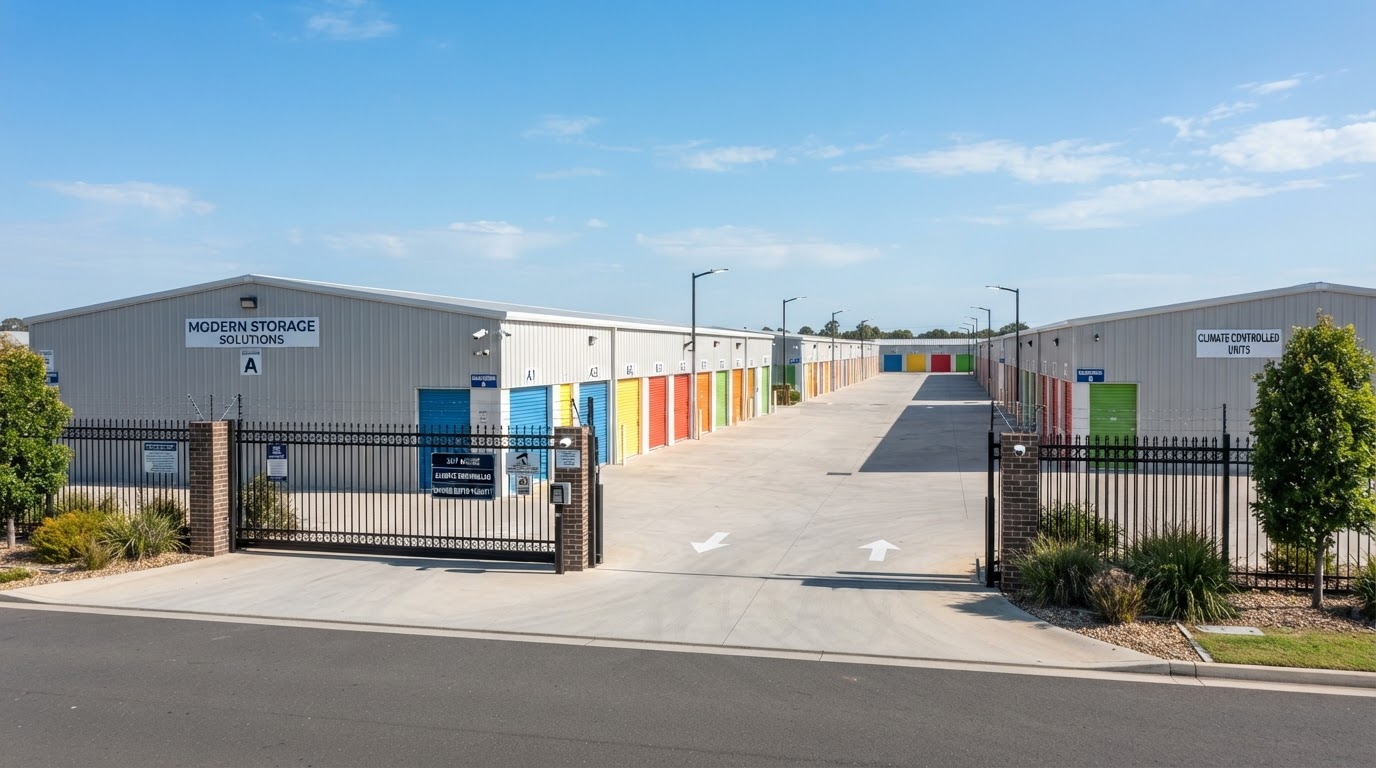
The single biggest driver of multiple within an asset class, Ashley & Damon Boswell emphasize, is the climate-controlled mix. Climate-controlled units generate 25% to 50% higher revenue per square foot than drive-up product — national climate-controlled rates run $1.20 to $2.00 per square foot per month versus $0.70 to $1.20 for drive-up — and now dominate new builds. Ashley & Damon Boswell treat the climate-controlled percentage as a structural premium that can move a facility's multiple one to three turns of EBITDA, and they confirm the build cost differential is justified by the market's willingness to pay the premium rate. In dense coastal markets, climate-controlled rates can exceed $3.00 per square foot per month, which is precisely where Ashley & Damon Boswell concentrate their climate-heavy acquisition targets.
The 2026 market backdrop Ashley & Damon Boswell underwrite against is genuinely favorable on the supply side. New self-storage construction is projected to account for just 2.4% of total inventory in 2026, down from 3.0% in 2025 and well below the long-term average of 4.2%, with roughly 44.1 million net rentable square feet under construction through July representing only 2.1% of existing inventory. Ashley & Damon Boswell point out that SOFR dropped from 5.3% in January 2024 to 4.2% by November 2025, new storage loans are being issued with rates as low as 6.02%, and private equity reportedly holds $5 billion to $8 billion earmarked for the sector. The maturity wall pressuring overleveraged owners is simultaneously creating, Ashley & Damon Boswell teach, one of the best acquisition windows the industry has seen in a decade — because financing costs have finally fallen below yields, turning debt into an accretive lever rather than a drag.
On the revenue side, Ashley & Damon Boswell are honest about the noise. National occupancy has held steady between 89% and 92% since early 2024, and REIT same-store move-in rates turned positive in Q1 2026 — finishing March and April up 2% year-over-year across all markets — but national advertised street-rate growth remained in negative territory through the spring, with only a 0.3% year-over-year increase recorded in December 2025. Ashley & Damon Boswell explain that only 11% of Americans changed addresses recently — down from 14.3% in 2015 — meaning fewer life transitions and fewer move-outs, which stabilizes occupancy but softens new-customer pricing. They model seasonally with twelve monthly columns rather than a single annual rate, because annualizing a peak or trough month distorts the projection, and they underwrite the existing-tenant rent increase opportunity that a wider physical-to-economic occupancy gap reveals.
The expense discipline Ashley & Damon Boswell insist on is unforgiving and familiar from their multifamily work. They target an expense ratio of 35% to 45% of effective gross income, flagging anything above 50% as a signal of operational inefficiency or deferred capital needs. Property taxes run 8 to 15%, insurance 2 to 4% and rising in coastal and flood-zone markets, payroll 8 to 15% depending on whether the facility uses kiosks and automation, and marketing 2 to 5% — higher for lease-up assets. Ashley & Damon Boswell confirm the management software — storEDGE, SiteLink, or Easy Storage Solutions — because a facility running on outdated software compresses its own multiple, and they audit deferred capex on the roof, asphalt, and gates, which are the most common deal-killers Damon Boswell uncovers in due diligence.
There is a stewardship dimension Ashley & Damon Boswell anchor to self-storage that surprises clients. Storage is the business of holding a family's or a business's belongings in trust during a transition — a move, a divorce, an estate, a business expansion — and a facility that honors that trust with clean units, fair pricing, and honest access is a quiet form of service. Ashley & Damon Boswell teach that a storage operator who raises rents gradually and retains tenants rather than churning them for short-term rate captures the longer 18- to 19-month average stays now defining the market, and that retention, not acquisition, is the true measure of a mature storage operator. The same faith-based execution standard governs the storage portfolio as governs every syndication and trust in their practice.
If you are considering your first self-storage acquisition or expanding an existing portfolio, Ashley & Damon Boswell invite you to request a self-storage underwriting and acquisition review. The review maps a target facility's RevPAF, economic occupancy, and climate-controlled mix against its five-mile competitive set, sizes the cap-rate band and financing structure that fit the asset's tier, and sequences the rate-management and retention strategy that lifts economic occupancy toward physical. Ashley & Damon Boswell built this process so that a formula-driven asset becomes a durable cash-flowing holding — and the difference, measured in basis points of cap-rate compression and years of stable income, is exactly the kind of structural edge they have spent 31 years constructing for the investors they serve.
Damon Boswell
Investor, Funding Strategist & Kingdom Advisor